Normalizing Heat Treatment Services in Bhosari | Pooja Heat Treat
Pooja Heat Treat offers prominent Normalizing Heat Treatment Services in Bhosari & Service Providers in Bhosari. Established in 2003, we utilize advanced furnaces and precisely controlled heating processes to ensure uniform temperature distribution across materials. This enables consistent metallurgical properties throughout each component, enhancing overall quality and performance.
To maintain high levels of safety, accuracy, and process stability, we strictly follow certified procedures and recognized quality standards. Our organization is committed to rigorous quality control practices and operates in compliance with accepted industry certifications and professional standards, ensuring reliable and consistent heat treatment results.
Basics of Normalizing Heat Treatment
As we are Normalizing Heat Treatment service providers in Bhosari. The certifications are evidence that the firm is committed to ensuring that it has quality management systems from 2 decades, safe operations, and reliable services to industrial clients. To achieve the required Normalizing Process Services requirements and industrial standards, every heat treatment process is closely supervised by highly qualified professionals to make sure that the end product is up to the standard. Thus, the normalizing process is thoroughly tailored based on the grade of material used, size of the component and industrial needs.
Types of Normalizing Heat Treatment
As Normalizing Heat Treatment Services in Bhosari, we offer different types according to treatment which are given below.
Full Normalizing (Air Normalizing): It is the most popular process, in which metal is heated. in still, ambient air and cooled above its upper critical temperature ( 30-50). It makes a fine uniform structure of ferritic-pearlitic.
Isothermal Normalizing: It is heated to austenite the metal then quenched at a rather high temperature in the intermediate range of the pearlite transformation (approximately 600 ) to create an extremely fine-grained, uniform structure.
Vacuum Normalizing: This is performed in a vacuum furnace to eliminate the surface oxidation and in most cases, nitrogen is used to cool down the furnace.
Process Normalizing (Accelerated Cooling): A variation in which forced air, oil, or water is used to accelerate the cooling process to produce a harder material with a finer microstructure than normal air cooling.
Step-by-Step Normalizing Heat Treatment Process
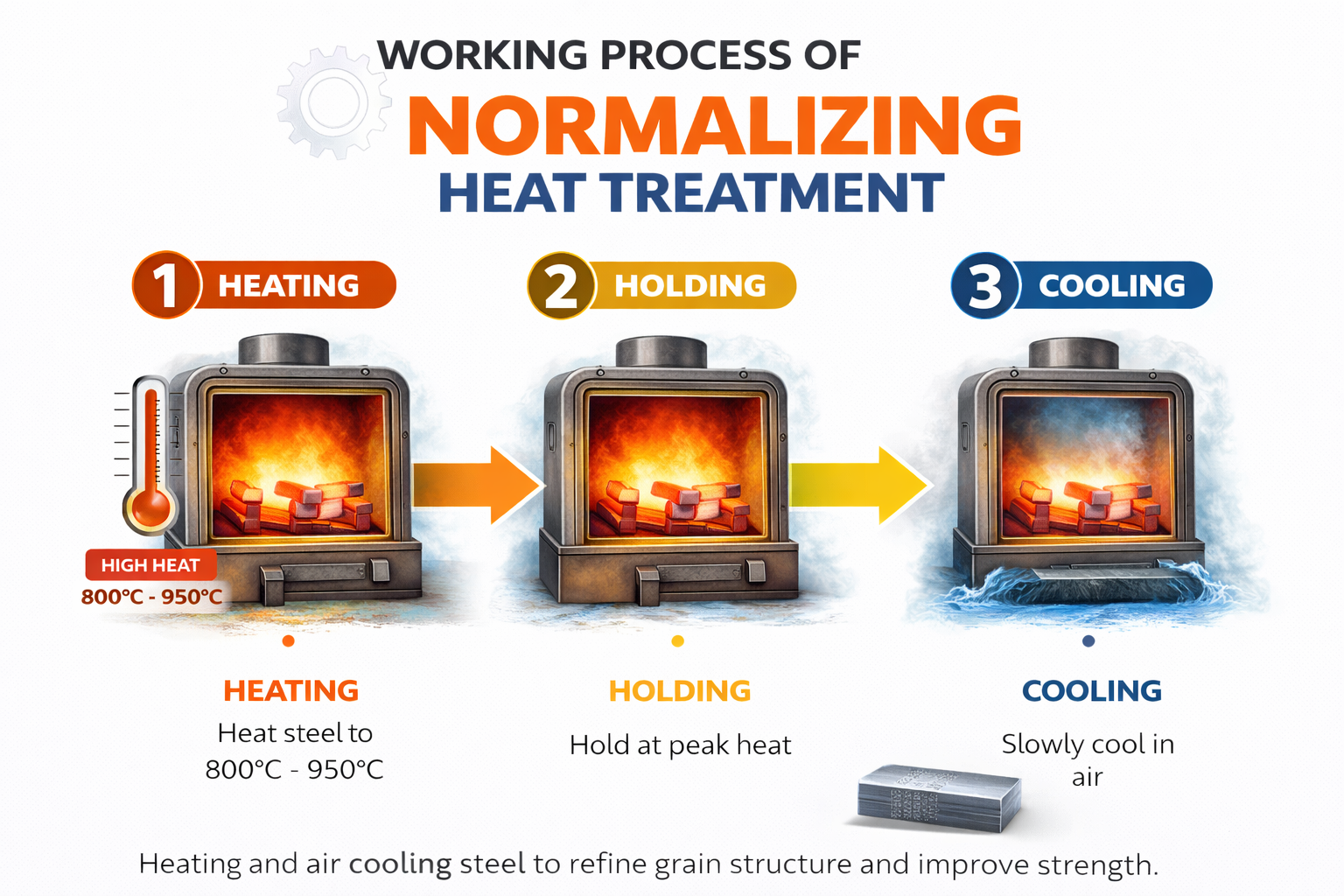
Following is working process of Normalizing Heat Treatment according to standard process.
Heating (Recovery Stage): The material is heated to a temperature above its upper critical temperature for hypo-eutectoid steel, for hyper-eutectoid steel). This stage breaks down existing, coarse, or distorted grains to prepare for reorganization.
Soaking (Recrystallization Stage): The material is held at this high temperature for a specific duration—typically 1 to 2 hours—to ensure uniform, homogeneous austenite structure throughout.
Air Cooling (Grain Growth Stage): The part is removed from the furnace and allowed to cool in still, ambient air. Because air cooling is faster than furnace cooling (used in annealing), it results in a finer, harder, and stronger pearlite/ferrite structure.
Homogenizing Structure: eliminates non-homogeneities of casting or forging.
Increasing Machinability: Increases consistency to proceed with processing.
Lessening Stresses: Removes internal stresses of past hot-working.
Key Benefits of Normalizing Heat Treatment
As Normalizing Heat Treatment Service providers in Bhosari, following are the benefits of normalization treatment according to strength which are given below.
Enhances Mechanical Strength. Normalizing refines internal grain structure of metal that enhances mechanical strength of metal. This increases reliability of components with regard to heavy industrial purposes.
Reduces Internal Stress In the manufacturing process, there are internal stresses that may be developed on the metals and may lead to distortion. Normalizing has the effect of de-stressing.
Improves Strength and Toughness. Normalized materials are made harder and more resistant to cracking or deformation. Normalizing Heat Treatment Job Work enables them to be used in heavy mechanical and construction works.
Increases Uniformity of Materials. The Normalizing Heat Treatment produces a more homogenous microstructure in the component of metal. The homogeneity of properties can be used to ensure consistency in performance.
Improves Machinability Further manufacturing processes of metals are more easily machinable and shaped when they are normalized. The polished grain’s structure provides ease of cutting and finishing.
Industrial Applications of Normalizing Heat Treatment
As Normalizing Heat Treatment Services in Bhosari, it is applicable in different sites which are given below.
Automotive Components Automobile parts like crankshafts, gears and axles are also commonly used with normalizing. The process enhances strength and wear-resistance of such components.
Massive Construction Machinery. Components of machineries in the heavy equipment are in need of great strength and hardness. Normalization is known to improve the life cycle of such components.
Forged Metal Parts Forged parts might need to be normalized to clean up their grain. This is done to eliminate anomalies that are created in the process of forging.
Industrial Machinery Parts Different industrial machines utilize the normalized steel parts in order to enhance performance. The procedure enhances wear and mechanical stress resistance.
Structural Steel Components. Constructive and structural engineering often involve the normalizing of steel. It enhances mechanical properties and stability.
Safety Guidelines and Compliance
Normalizing Heat Treatment services are guided by stringent industrial safety and quality criteria in the process of ensuring reliable and safe handling of metal components. The temperature and furnace control should be made proper to ensure that the same results are obtained and no defects of the materials are created. Adherence to quality management systems and industrial safety standards causes all of the components.
Experienced Technical Team We have a capable workforce that has high level of competency in heat treatment processes. Their expertise guarantees proper control of temperature.
State-of-the-art Heat Treatment Plant. Modern furnace and controlled heating systems are applied in order to process accurately. This provides even dispersion of heat and even treatment.
Strict Quality Control All the heat treatment processes are strictly checked and reviewed. Our quality processes are such that all parts are of the necessary engineering standards.
Pooja Heat Treat offers well-known Normalizing Heat Treatment Services in Bhosari. The process helps in refining the internal structure of steel and increases its strength, machinability, and reliability to be used in industrial applications that are very demanding. Trustworthy Normalizing Heat Treatment services of different industries with professional knowledge, latest equipment, and high-quality practices. The company concentrates on providing stable outcomes that will improve the performance and life cycle of industrial products.
Today Get in touch with our team and talk about your heat treatment needs. Contact us today and enjoy trusted heat treatment services that will help in making you successful in manufacturing.
FAQs
Normalizing is a process in which metal is heated and then cooled in air at a particular temperature. It enhances the strength, mechanical properties and the grain structure of the material.
Normalization straightens the steel internal structure and eliminates the internal stresses. This enhances toughness, strength and consistency of the material.
This process is normally used in industries like automotive, construction, heavy engineering, and machinery production to enhance the performance of the metal.
The process results in a homogenous graining design that enables easier cutting and shaping. This simplifies and streamlines machining processes.
Hi there! 👋
Fill out the form below to start a conversation with us on WhatsApp.
Hi there! 👋
Fill out the form below to start a conversation with us on WhatsApp.